Metal Beam Weight Calculator
Accurately estimate the weight of structural steel, aluminum, copper, titanium, and brass beams. Select from I-beam, H-beam, rectangular tube, C-channel, angle, or round bar profiles. Enter dimensions and length, and get instant mass, linear density, cross-sectional area, and volume
Compressed Disclaimer: Weights shown are for reference only and not for precision-critical calculations. Actual weight and density may differ significantly due to manufacturing processes and material composition. For accurate data, consult the manufacturer directly.
Why Accurate Metal Beam Weight Estimation Matters
In structural engineering, construction, and manufacturing, the weight of a metal beam is a critical parameter that influences load calculations, material selection, transportation logistics, and overall project cost. Whether you are designing a high-rise steel frame, a bridge girder, or a custom machinery component, knowing the exact mass of each beam ensures structural integrity and efficient resource planning.
The fundamental relationship for beam weight:
W = ρ × A × L
where ρ = material density, A = cross-sectional area, L = length
Understanding Beam Profiles and Their Applications
Each beam profile is engineered for specific structural purposes:
- I-Beam (Wide Flange): The most common structural steel shape, offering excellent strength-to-weight ratio for bending about its major axis. Used in building frames, bridges, and crane runways.
- H-Beam: Similar to I-beam but with wider flanges and thicker web, providing superior strength in both axes. Ideal for columns and heavy-load applications.
- Rectangular Hollow Section (RHS): Closed section with high torsional stiffness and aesthetic appeal. Widely used in architectural structures, trusses, and machinery frames.
- C-Channel: Open section with a distinctive C-shape, often used for light structural framing, purlins, and girts in building construction.
- Angle (L-Section): Simple L-shaped section, commonly used for bracing, brackets, and lightweight framing.
- Round Bar: Solid cylindrical section, used in shafts, axles, and as raw material for machining.
Material Density Reference
| Material | Density (kg/m³) | Typical Applications |
|---|---|---|
| Carbon Steel | 7,850 | Structural beams, general fabrication |
| Stainless Steel | 8,000 | Corrosion-resistant structures, food processing |
| Aluminum | 2,700 | Lightweight structures, aerospace, automotive |
| Copper | 8,960 | Electrical conductors, heat exchangers, roofing |
| Brass | 8,500 | Decorative hardware, fittings, musical instruments |
| Titanium | 4,500 | Aerospace, medical implants, marine applications |
How the Calculator Works — Step by Step
- Select Profile: Choose the beam type that matches your structural section.
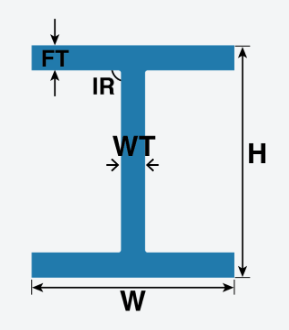
- Enter Dimensions: Input the key geometric parameters (height, flange width, thicknesses, etc.) in millimeters.
- Specify Length: Enter the beam length in meters.
- Choose Material: Pick the material from the dropdown — density values are pre-loaded from standard engineering references.
- Calculate: The tool computes cross-sectional area using profile-specific formulas, then multiplies by density and length to obtain total weight.
- Visualize: The cross-section is drawn on canvas with dimensional annotations, helping you verify the geometry.
Cross-Sectional Area Formulas Used
- I-Beam / H-Beam: A = 2·b·tf + (h − 2·tf)·tw
- Rectangular Tube: A = H·W − (H − 2·t)·(W − 2·t)
- C-Channel: A = 2·b·tf + (h − 2·tf)·tw
- Angle: A = 2·L·t − t²
- Round Bar: A = π·(d/2)²
All dimensions in millimeters, area in mm². Weight = A (mm²) × L (m) × ρ (kg/m³) × 10⁻⁶.
Engineering Applications and Case Studies
Case Study: Steel Frame for a Commercial Building
A structural engineer is designing a 4-story office building with a steel frame. The primary beams are W18×50 (I-beam) sections spanning 10 meters. Using this calculator, the engineer estimates the weight per beam at approximately 500 kg (based on 18″ height, 6″ flange, and 50 lb/ft linear density). For 60 beams, the total steel weight is 30 metric tons. This informs the crane selection, foundation design, and shipping cost estimation. The interactive profile view helps the engineer verify that the section matches the design drawings before ordering.
Case Study: Transport Logistics for Structural Steel
A steel fabricator needs to ship 200 meters of RHS 150×150×8 (rectangular hollow section) to a construction site. Using the calculator with aluminum material (density 2700 kg/m³), the total weight is computed as 200 × 7.85 kg/m ≈ 1,570 kg. This allows the logistics team to select an appropriate truck with the correct load capacity, avoiding overweight fines and ensuring safety on the road.
Common Misconceptions About Beam Weight Calculation
- “Weight is proportional only to length.” — False. Weight depends on cross-sectional area and density as well. A larger profile can weigh many times more per meter than a smaller one, even at the same length.
- “All steel has the same density.” — Not exactly. Carbon steel is ~7850 kg/m³, but stainless steel is ~8000 kg/m³, and alloy steels can vary. Using the correct density is essential for precision.
- “The profile drawing is just for show.” — The visual cross-section helps verify that the dimensions entered match the intended structural shape, reducing errors in material ordering.
- “Weight calculation doesn’t affect structural safety.” — Underestimating beam weight can lead to undersized supports, overloading, and potential structural failure. Accurate estimation is a cornerstone of safe design.
Industry Standards and References
This calculator aligns with the following international standards and engineering references:
- AISC Steel Construction Manual — Standard dimensions and properties for structural steel shapes.
- EN 10210 / EN 10219 — European standards for hollow sections.
- ASTM A6/A6M — Standard specification for rolled structural steel shapes.
- ISO 657 — International standard for steel sections.
- AS/NZS 3679 — Australian/New Zealand standard for structural steel.
Density values are sourced from authoritative materials science data (MatWeb, ASM International, and standard engineering handbooks).