Round Tube Weight Calculator
Instantly compute the mass, weight per unit length, cross-sectional area, and volume of any round tube (hollow cylinder) based on outer diameter, wall thickness (or inner diameter), length, and material density.
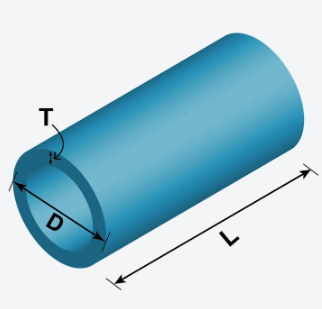
The weights shown are for general reference only and are not intended for use in precise calculations. Manufacturing tolerances and material composition can cause actual weights to differ. For accurate figures, please obtain official data from the manufacturer.
What Is a Round Tube Weight Calculator?
A round tube weight calculator is an engineering tool that computes the mass of a hollow cylindrical section (tube or pipe) based on its outer diameter, wall thickness (or inner diameter), length, and material density. This is essential for structural design, material procurement, shipping logistics, and cost estimation in industries ranging from construction to aerospace.
Cross‑sectional Area: A = π/4 · (D² − d²) = π · t · (D − t)
Volume: V = A · L | Weight: W = V · ρ
where D = outer diameter, d = inner diameter, t = wall thickness, L = length, ρ = density
Why Use an Interactive Tube Weight Estimator?
- Engineering Precision: Quickly obtain accurate mass values for structural calculations, eliminating manual errors in formula application.
- Material Selection: Compare weights across different materials — steel, aluminum, copper, titanium — to optimize for strength-to-weight ratio and cost.
- Logistics & Shipping: Estimate freight costs based on accurate tube weights for better budgeting and load planning.
- Educational Tool: Visualize the relationship between tube dimensions and cross‑sectional area, reinforcing understanding of geometric principles in engineering.
Mathematical Derivation & Engineering Context
The round tube (hollow cylinder) is one of the most common structural shapes in engineering. Its cross‑sectional area is the difference between the areas of two concentric circles: the outer circle (diameter D) and the inner circle (diameter d). This area directly determines the tube's resistance to axial forces, bending, and torsion.
The formula A = π · t · (D − t) is particularly useful when wall thickness is known, as it highlights that the area is proportional to the product of thickness and the mean circumference. This relationship is fundamental in thin‑walled pressure vessel design (ASME Boiler and Pressure Vessel Code) and in the analysis of tubular structures.
For weight calculation, the volume is multiplied by the material density. Density values vary with alloy composition and temperature; the values provided in this tool are based on ASTM and ASM International standards at 20°C. For high‑precision applications, always verify density with material test certificates.
The weight per unit length (kg/m or lb/ft) is a critical parameter for structural engineers designing beams, columns, and trusses. It appears in structural steel manuals (e.g., AISC Steel Construction Manual) and is used to compute dead loads in building design.
Material Density Reference Table
Densities are provided at standard room temperature (20°C). Values are sourced from ASM Handbook, Volume 2: Properties and Selection of Nonferrous Alloys, and ASTM standards.
| Material | Density (g/cm³) | Density (lb/in³) | Common Applications |
|---|---|---|---|
| Carbon Steel (AISI 1020) | 7.85 | 0.284 | Structural tubing, pipes, machinery |
| Stainless Steel 304 | 7.90 | 0.285 | Food processing, chemical equipment |
| Stainless Steel 316 | 7.93 | 0.286 | Marine, pharmaceutical, high‑corrosion |
| Aluminum 6061-T6 | 2.70 | 0.098 | Aerospace, automotive, structural |
| Aluminum 7075-T6 | 2.71 | 0.098 | High‑strength aerospace components |
| Copper (C110) | 8.96 | 0.324 | Electrical, plumbing, heat exchangers |
| Brass (C360) | 8.50 | 0.307 | Fittings, valves, decorative |
| Titanium (Grade 5) | 4.50 | 0.163 | Aerospace, medical implants, racing |
| Nickel 200 | 8.90 | 0.322 | Chemical processing, electronics |
| Zinc | 7.14 | 0.258 | Galvanizing, die‑casting |
| Lead | 11.34 | 0.410 | Radiation shielding, batteries |
| Cast Iron (Gray) | 7.80 | 0.282 | Engine blocks, pipes, machinery bases |
Real‑World Applications & Case Studies
Case Study 1: Structural Steel Column Design
A structural engineer is designing a multi‑story building using circular hollow sections (CHS) as columns. The selected tube has an outer diameter of 219.1 mm and a wall thickness of 6.3 mm, with a length of 4.5 m per floor. Using carbon steel density (7.85 g/cm³), the calculator returns a weight per meter of 33.05 kg/m, giving a total column weight of 148.7 kg per floor. This data is used to compute dead loads, foundation sizing, and crane lifting requirements. The interactive visualization helps the engineer confirm that the cross‑sectional area (4,213 mm²) matches the design specifications.
Case Study 2: Aerospace Tubing Weight Optimization
An aerospace engineer is optimizing the weight of a hydraulic tubing system for an aircraft. The baseline design uses titanium (Grade 5) tubing with OD = 25.4 mm and WT = 1.2 mm. By switching to aluminum 7075 (density 2.71 g/cm³), the weight per meter drops from 0.34 kg/m to 0.20 kg/m — a 41% reduction — while maintaining adequate strength for the operating pressure. This weight saving translates directly to fuel efficiency and increased payload capacity. The calculator's ability to quickly compare materials makes it an indispensable tool in the design loop.
Case Study 3: Pipeline Logistics & Cost Estimation
A pipeline contractor needs to estimate shipping costs for 12‑meter lengths of steel pipe with OD = 323.9 mm and WT = 9.5 mm. Using the calculator, the weight per meter is 73.6 kg/m, so each 12‑m joint weighs 883 kg. For a 10‑km pipeline, the total steel weight is approximately 7,358 tonnes. This information is used to negotiate freight rates, plan lifting equipment, and estimate material costs with ±1% accuracy.
Industry Standards & Technical References
- ASTM A500 / A501: Standard specification for cold‑formed welded and seamless carbon steel structural tubing.
- ASTM B210 / B241: Standards for aluminum and aluminum‑alloy drawn seamless tubes.
- ASME B36.10M: Welded and seamless wrought steel pipe dimensions and weights.
- ISO 4200: Plain end steel tubes for general purposes — dimensions and masses per unit length.
- ASM Handbook Vol. 2: Comprehensive material property data including density, thermal expansion, and mechanical properties.
The calculator's density values are cross‑referenced with the above standards to ensure reliability for engineering applications.
Common Mistakes & Misconceptions
- Confusing inner diameter with wall thickness: Always verify whether you are inputting the inner diameter or the wall thickness. The calculator supports both, but mixing them will yield incorrect results.
- Using incorrect density: Alloy composition and temperature affect density. Always use density values specific to your material grade and condition.
- Ignoring units: Double‑check that dimensions are in consistent units (e.g., all in mm for cross‑section, length in m). The calculator handles conversions, but inputs should be consistent.
- Assuming uniform wall thickness: In practice, tubes may have tolerances and ovality. The calculator assumes ideal geometry; for critical applications, consider manufacturing tolerances (ASTM A450).
Step‑by‑Step Usage Guide
- Enter the outer diameter (D) in millimeters.
- Choose whether to specify wall thickness (t) or inner diameter (d) using the toggle buttons.
- Enter the corresponding value in millimeters.
- Specify the length (L) in meters.
- Select a material from the dropdown — the density will auto‑fill. For custom alloys, choose "Custom Density" and enter your value.
- Choose your preferred output unit system: metric (kg, m) or imperial (lb, ft).
- Click "Calculate Weight" to see the results and the interactive cross‑section diagram.
- Use the example presets to quickly explore common tube sizes and materials.