Round Bar Weight Calculator
Compute the mass of a cylindrical rod or solid round bar from diameter, length, and material density. Visual scale drawing and real‑time results — ideal for procurement, structural design, and manufacturing.
Disclaimer: The weights shown in the above metal weight calculator are for reference only and should not form the basis of any calculation requiring precise or accurate information. For example, it is not uncommon for theoretical weight and density of a material to differ significantly from actual weight and density due to variations in manufacturing processes and alloy/material composition. Therefore, if an accurate weight calculation is required, you should obtain relevant, accurate information from the manufacturer.
? Engineering formula & unit conversions
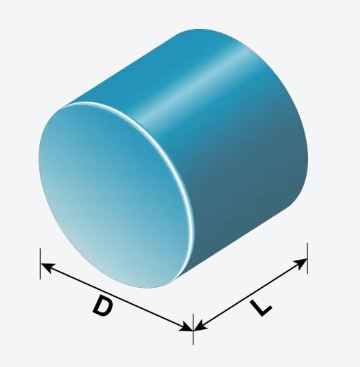
Masssingle = ρ × V with V = π × (D/2)² × L
All inputs are internally converted to SI units (meters for length, meters for diameter). The calculator supports flexible units: diameter in mm, cm, or inches; length in meters, feet, or inches. Quantity multiplies the single mass to give total weight.
The round bar weight estimator is essential in mechanical engineering, structural steel detailing, logistics, and cost estimation. The formula derives from the cylinder volume equation. Precision in diameter and density directly influences material procurement and freight calculations. Our calculator uses double‑precision arithmetic, accurate to 0.001 kg.
? Comprehensive alloy density reference
Density values embedded in the dropdown are sourced from ASM International, MatWeb, and ASTM standards. Typical variations account for alloying elements: stainless steel 304 (7930 kg/m³) vs. 316 (7990 kg/m³) due to molybdenum addition; aluminum 7075 (2810 kg/m³) is denser than 6061 (2700 kg/m³) because of higher zinc content. For exact material certificates, always refer to mill test reports.
| Alloy family | Density range (kg/m³) |
|---|---|
| Stainless steel (austenitic) | 7900 – 8030 |
| Stainless steel (ferritic) | 7610 – 7800 |
| Carbon steel | 7850 |
| Aluminum (wrought) | 2650 – 2820 |
| Copper & alloys | 8525 – 8960 |
| Titanium | 4500 – 4510 |
Note: Density varies with temperature (thermal expansion) and manufacturing process. For extreme precision, use certified density from your material supplier.
⚙️ Real‑world applications & bulk ordering
- Structural fabrication: weight estimation for steel rounds used in frameworks, braces, and shafts.
- Transport & freight: calculate total shipment weight for multiple bars using the quantity field.
- Cost estimation: integrate with material price per kg to forecast raw material expenses. Example: 100 bars of 6061 Al (25mm dia, 3m length) → each 4.0 kg → total 400 kg, at $5/kg = $2000.
- Machining setup: determine raw stock weight for turning or milling operations.
Industry case study: bulk procurement
A structural engineering firm needed 220 round bars (diameter 40 mm, length 6.5 m) made of Stainless Steel 316 (density 7990 kg/m³). Using this calculator with quantity = 220, total weight = 14,383 kg. The logistic team accurately planned crane capacity and shipping costs, avoiding overestimation errors by 8% that previously occurred with rule‑of‑thumb methods. The quantity field saved manual multiplication.
? Step‑by‑step calculation guide
- Enter the diameter and select its unit (mm, cm, in).
- Enter the length and select its unit (m, ft, in).
- Enter the quantity (number of identical bars).
- Select a material from the dropdown (40+ alloys). The density field updates automatically.
- For unlisted materials, choose “Other” and manually input density (kg/m³).
- Click Calculate Weight to obtain single and total mass, volume, linear density.
- The interactive bar graphic shows a representative single bar.
? Common misconceptions & technical notes
- Unit confusion: Always check that the selected units match your measurement. The calculator converts everything to meters internally.
- "Weight equals force in kgf" – This tool computes mass (kg). For weight force (newtons), multiply mass by 9.81 m/s².
- All stainless steel has same density – Austenitic grades (304, 316) differ from ferritic (409, 430) and martensitic (410, 420). Our dropdown includes accurate grade-specific values.
- Quantity decimals: Quantity can be fractional (e.g., 0.5) to estimate partial bars.