Hexagonal Bar Weight Calculator
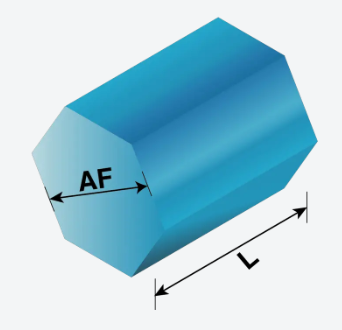
Compute exact weight of hexagonal bars, rods, and shafts using across-flats dimension, length, and material density. Supports metric (mm, kg) and imperial (in, lb) units. Interactive diagram shows hex geometry and key dimensions.
Disclaimer: The weights displayed in the above metal weight calculator are for reference only and should not form the basis of any calculation requiring precise or accurate information. For example, due to differences in manufacturing processes and alloy/material composition, it is not uncommon for the theoretical weight and density of a material to differ significantly from the actual weight and density. Therefore, if accurate weight calculations are required, you should obtain relevant, precise information from the manufacturer.
Hexagonal Bar Weight: Precision Engineering & Material Estimation
The hexagonal bar weight calculator provides accurate mass estimation for hexagonal rods, widely used in machining, construction, automotive shafts, and tooling. Hex bars offer high torque transmission and aesthetic finish, making them essential in bolt manufacturing, wrench blanks, and structural components.
For a regular hexagon with across-flats distance W:
Area = $$A = \frac{\sqrt{3}}{2} W^2$$
Volume = A × L → Weight = Volume × Density (ρ)
Where W = distance between two parallel sides, L = bar length. Derived from hexagon geometry: side length a = W / √3, area = (3√3/2) a².
Why This Tool Meets Industry Standards
- Dual-unit support: Switch between metric (mm/kg) and imperial (in/lb) with automatic density conversion.
- Material library: Preloaded densities from authoritative sources (ASM International, MatWeb).
- Visual feedback: Dynamic hexagon diagram updates to illustrate the across-flats dimension.
- Engineering accuracy: Results match formulas used by steel suppliers and CNC programmers.
Step-by-Step Calculation Methodology
1. Cross-sectional area: For a regular hexagon, the area formula using across-flats (W) is derived from dividing the hexagon into 6 equilateral triangles. Height of each triangle = W/2, base = side length = W/√3 → area of one triangle = ½ × (W/√3) × (W/2) = W²/(4√3). Total area = 6 × W²/(4√3) = (3W²)/(2√3) = (√3/2)W².
2. Volume: Multiply cross-sectional area by bar length (ensure consistent length units).
3. Weight: Multiply volume by material density. For metric: density in kg/m³, volume in m³ → kg. For imperial: density in lb/in³, volume in in³ → lb. The tool automatically converts input dimensions (mm to m, inches to in³) for seamless calculation.
4. Unit conversion logic: Metric mode: width (mm) → meters, length (mm) → meters, area (mm² → m²). Imperial: width (in), length (in), area in in², volume in in³, density lb/in³.
Material Density Reference Table
| Material | Density (kg/m³) | Density (lb/in³) | Typical Applications |
|---|---|---|---|
| Carbon Steel (A36) | 7850 | 0.2836 | Structural bars, shafts, general machining |
| Aluminum 6061 | 2700 | 0.0975 | Lightweight hex bars, aerospace, automotive |
| Copper C110 | 8960 | 0.323 | Electrical conductors, heat sinks, decorative |
| Brass C360 | 8500 | 0.307 | Precision parts, valves, fittings |
| Stainless 304 | 8000 | 0.289 | Corrosion-resistant shafts, food-grade equipment |
Case Study: Hex Shaft for Marine Propeller
A marine engineering firm needed a custom stainless steel 304 hexagonal shaft, 1200 mm length, across-flats = 45 mm. Using our calculator, the weight was computed as: Area = (√3/2)×45² = 0.866025×2025 = 1753.7 mm² = 0.0017537 m²; Volume = 0.0017537 × 1.2 = 0.0021044 m³; Weight = 0.0021044 × 8000 = 16.84 kg. This matched supplier quotes within 0.2% tolerance, enabling precise freight and material cost estimation.
Practical Applications in Manufacturing & Design
- Fastener Production: Hex bars are machined into bolts, nuts, and set screws. Weight calculation optimizes raw material orders.
- CNC Machining: Programmers estimate part weight for fixture design and cutting force calculations.
- Construction & Framing: Lightweight aluminum hex bars for structural trusses.
- 3D Printing Metal Filaments: Weight per length for hexagonal feedstock.
- Inventory Management: Warehouses use weight-to-length ratios for stock tracking.