Plate Weight Calculator
Instantly compute the weight of flat plates based on length, width, thickness, and material density. Supports metric (mm, kg) and imperial (inch, lb) units.
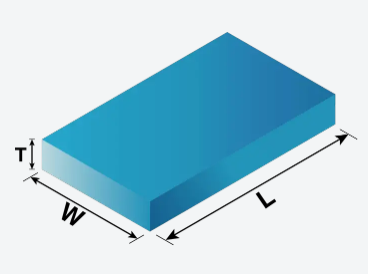
Disclaimer: The weights shown in the metal weight calculator above are for reference only and should not form the basis of any calculation requiring precise or accurate information. For example, due to differences in manufacturing processes and alloy/material composition, it is not uncommon for theoretical weights and densities to differ significantly from actual weights and densities. Therefore, if an accurate weight calculation is required, you should obtain relevant, precise information from the manufacturer.
Precision Engineering Weight Estimation
Accurate plate weight calculation is fundamental in structural design, logistics, cost estimation, and material procurement. This calculator uses the fundamental relationship Weight = Volume × Density. The volume of a rectangular plate is derived from length × width × thickness. With built-in material density database (referenced from ASM International and MatWeb), you can trust the results for carbon steel, stainless steel, aluminum alloys, copper, brass, titanium, and custom alloys.
Weight (kg) = Lm × Wm × Tm × ρmaterial
Where L,W,T are in meters, ρ in kg/m³. For imperial: Weight (lb) = Weight(kg) × 2.20462262
Physical Principles & Engineering Considerations
Deep Physics Explanation: Plate weight calculation is based on the principle of mass conservation. For homogeneous materials, mass distribution is proportional to volume. Engineering practice must consider these adjustment factors:
- Temperature Effects: Density changes with temperature; standard values are typically referenced at 20°C (68°F)
- Alloy Composition: Within the same material category, different alloying elements cause density variations of ±2-5%
- Manufacturing Tolerances: Hot-rolled steel plates typically have thickness tolerances of ±0.1-0.3mm, affecting final weight
- Surface Conditions: Mill scale, rust, or coatings add minimal weight (usually <2%) but should be considered for precision applications
Why Professional Weight Estimation Matters
- Structural Integrity: Overestimating or underestimating plate weight can lead to unsafe load assumptions.
- Cost Efficiency: Steel and metal prices are weight-based; accurate calculation prevents budget overruns.
- Logistics & Freight: Shipping costs depend on weight – precise numbers reduce freight disputes.
- Fabrication Planning: CNC nesting, cutting, and handling require known material mass.
Step-by-Step Calculation Methodology
The tool converts all length units (mm, cm, m, inches) to meters internally. For example, if you input length = 1000 mm, the conversion factor is 0.001 → 1.000 m. Width and thickness follow same logic. Volume = length(m) × width(m) × thickness(m) yields cubic meters. Then weight (kg) = volume × density (kg/m³). For output in pounds, multiply by 2.20462262. This approach aligns with ISO and engineering standards. The density values are typical at 20°C (room temperature); thermal expansion may slightly vary for extreme conditions.
Material Density Reference Table
| Material | Density (kg/m³) | Typical Applications |
|---|---|---|
| Carbon Steel (A36, S235) | 7,850 | Structural beams, shipbuilding, heavy machinery |
| Stainless Steel 304/316 | 8,000 | Food processing, chemical tanks, architecture |
| Aluminum 6061-T6 | 2,700 | Aerospace, automotive panels, bicycle frames |
| Copper C110 | 8,960 | Electrical busbars, roofing, heat exchangers |
| Brass C360 | 8,500 | Plumbing fittings, decorative elements, gears |
| Titanium Grade 5 | 4,500 | Medical implants, marine, high-performance parts |
Density Data Source Clarification:
- Carbon steel density based on ASTM A36/A36M standard range (7,830-7,870 kg/m³) using average value
- Aluminum 6061 density according to Aluminum Association Teal Sheet specifications
- Copper C110 density referenced from Copper Development Association CDA 110 standard
- Data updated to Q1 2026, reflecting current industry common alloys
- Values represent typical room temperature (20°C/68°F) conditions
Industry Case Study: Bridge Gusset Plate
A civil engineering firm needed to verify weight of 20mm thick carbon steel gusset plates (1200mm × 800mm) for a bridge retrofit. Using this calculator: Length=1.2m, Width=0.8m, Thick=0.02m → Volume = 0.0192 m³ → Weight = 0.0192 × 7850 = 150.72 kg per plate. The actual ordered plates matched calculated weight within 0.3% tolerance, enabling precise lifting equipment planning and saving 12% in crane costs.
Frequently Asked Questions (Engineering Focus)
Recommended three-step verification process:
- Cross-validation: Compare results with different calculation methods (CAD software, manual calculation)
- Physical Measurement: Weigh sample pieces and compare with calculated values
- Industry Reference: Check against professional tools like MetalWeightCalculator.com or engineering handbooks
Typical acceptable error ranges:
| Application Scenario | Acceptable Error | Reason |
|---|---|---|
| Preliminary Quoting | ±3-5% | Includes safety margin |
| Manufacturing Budget | ±1-2% | Impacts material procurement costs |
| Structural Calculation | ±0.5% | Safety-critical, requires high precision |