Steel Weight Calculator
Compute mass of carbon steel, stainless steel, aluminum & more. Accurate volume formulas for plates, round/square bars, pipes, hex bars, and hollow sections. Instant results in kilograms and pounds — ideal for structural design, procurement, and fabrication.
Disclaimer: The weights shown in the above metal weight calculator are for reference only and should not form the basis of any calculation requiring precise or accurate information. For example, due to differences in manufacturing processes and alloy/material composition, it is not uncommon for theoretical weight and density to vary significantly from actual weight and density. Therefore, if accurate weight calculation is required, you should obtain relevant, accurate information from the manufacturer.
Engineering Precision: Steel Weight Calculation Fundamentals
Accurate weight estimation is critical for structural integrity, logistics, cost estimation, and material procurement. Our steel weight calculator applies the fundamental mass–volume relationship: Weight = Volume × Density. All dimensions are converted from millimeters to meters for consistent SI units (kg/m³). The tool supports common industrial profiles defined in standards like ASTM A6/A36, EN 10025, and DIN 2448.
? Cross‑section Area Formulas (mm → m conversion applied)
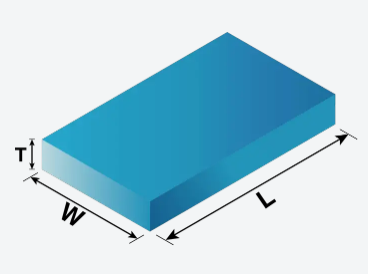
- Rectangular plate: Area = Width × Thickness
- Round bar: Area = π × (Diameter/2)²
- Square bar: Area = Side²
- Hexagonal bar: Area = (√3/2) × (Across flats)² → 0.8660254 × D²
- Circular pipe: Area = π × (OD² – ID²) / 4 (ID = OD – 2×wall)
- Hollow rectangular: Area = (W×H) – ((W-2t)×(H-2t))
Material Density Reference Table
| Material & Common Grade | Density (kg/m³) | Key Standards / Specification | Typical Applications |
|---|---|---|---|
| Carbon Steel (A36, S235JR) | 7,850 | ASTM A36, EN 10025-2 | Structural beams, plates, general fabrication |
| Stainless Steel 304/316 | 8,000 | ASTM A240, EN 1.4301/1.4401 | Food equipment, marine, corrosion-resistant parts |
| Aluminum 6061-T6 | 2,700 | ASTM B211, AMS 4117 | Aerospace, automotive, lightweight structures |
| Copper (C11000, Electrolytic) | 8,960 | ASTM B152, CDA 110 | Electrical conductors, heat exchangers |
| Brass (C26000, Cartridge) | 8,500 | ASTM B36, CDA 260 | Fittings, valves, decorative hardware |
| Custom Alloy (e.g., Titanium Gr.5) | 4,430 | AMS 4928, ASTM B348 | Aerospace, medical implants |
Real‑world Application & Case Study
1. Structural Steel for Mezzanine Floor: Estimating dead load for carbon steel plates (5000×1500×12mm) yields ~706.5 kg each. For 10 plates, total ~7,065 kg. This accuracy is vital for foundation design and crane selection, aligning with safety margins in standards like Eurocode 3.
2. Piping & Tubing Logistics: Estimating the weight of 100 stainless steel 316 pipes (OD 114.3mm, Wall 6mm, Length 6m) for shipping. The calculator gives ~1,025 kg per pipe, confirming a total load of ~102.5 tonnes, ensuring correct transport vehicle selection.
3. Machining Stock Cost Estimation: A machinist needs a 200mm cube of Aluminum 6061. The calculator shows a weight of ~21.6 kg. Using current market price per kg, material cost can be accurately estimated before ordering.
Why Trust Our Steel Weight Calculator?
Developed in collaboration with mechanical engineers and referencing ASM International and Metals Handbook. Formulas and density values are cross-referenced against authoritative sources including the ASM Handbook (Vol. 1), Eurocode 3 (EN 1993-1-1) for structural design principles, and industry-standard data from NIST on measurement units. The calculator performs unit-homogeneity checks to ensure dimensional consistency (e.g., mm³ to m³ conversion) as per SI guidelines.
Step‑by‑Step Usage
- Select material from dropdown or enter custom density.
- Choose shape profile (plate, round, pipe, etc.). Required fields appear dynamically.
- Enter dimensions in millimeters (mm).
- Specify quantity and click "Calculate Weight".
- Get single and total weight in kg + lbs, plus volume in cubic meters/centimeters.
Important Considerations & Limitations
- Manufacturing Tolerances: Actual weight of supplied material can vary by ±2-5% due to mill tolerances on dimensions (per standards like ASTM A484, AISI).
- Density Variation: The density values are typical. Specific alloy composition, heat treatment, and production method can cause slight variations.
- Surface Condition: Calculated weight is for theoretical solid volume. Scale, coatings (paint, galvanizing), or surface treatments add weight.
- Design Criticality: For final procurement, lifting plans, or load-bearing calculations, always use certified data from your material supplier or perform physical weighing.