Tube Weight Calculator
Accurately estimate the weight of metal tubes based on shape, dimensions, length, and material density. Includes interactive cross‑section preview, material database, and engineering formulas.
Disclaimer: The weights shown in the metal weight calculator above are for reference only and should not form the basis of any calculation requiring precise or accurate information. For example, due to differences in manufacturing processes and alloy/material composition, it is not uncommon for theoretical weights and densities to differ significantly from actual weights and densities. Therefore, if an accurate weight calculation is required, you should obtain relevant, precise information from the manufacturer.
Engineering Precision: Tube Weight Calculation
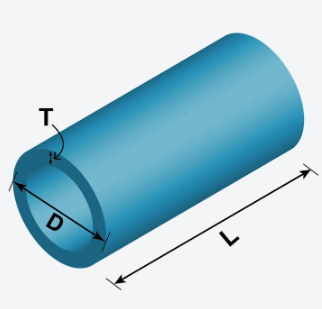
The Tube Weight Calculator provides accurate mass estimates for round, square and rectangular hollow sections. Weight = Volume × Density, where volume is derived from the cross‑sectional area multiplied by length. This is essential for structural design, logistics, cost estimation, and material procurement in construction, automotive, and aerospace industries.
✔️ Round tube area: A = π × (OD² − ID²) / 4, ID = OD − 2×WT
✔️ Square tube area: A = A_outer² − (A_outer − 2t)²
✔️ Rectangular tube area: A = W×H − (W−2t)×(H−2t)
Weight (kg) = A (mm²) × 10⁻⁶ × L (m) × ρ (kg/m³)
Note: The factor 10⁻⁶ converts mm² to m², ensuring dimensional consistency. Unit consistency is critical in engineering calculations.
Standards and Tolerances
Theoretical Weight vs. Actual Weight: This calculator provides the theoretical weight based on nominal dimensions. In production, tube weight is subject to manufacturing tolerances permitted by international standards.
Key Standards:
- ASTM A500 (Standard Specification for Cold-Formed Welded and Seamless Carbon Steel Structural Tubing in Rounds and Shapes) – Defines dimensional and weight tolerances for structural tubing.
- ASTM A53 (Standard Specification for Pipe, Steel, Black and Hot-Dipped, Zinc-Coated, Welded and Seamless) – Governs pipe dimensions and weights.
- EN 10219 (Cold formed welded structural hollow sections of non-alloy and fine grain steels) – European standard for tolerances on dimensions and mass.
For critical structural applications, always refer to the specific procurement standard and consult supplier mill certificates for actual weights, which can vary within the permissible tolerance range (typically ±5% to ±10% on mass for many tube products).
Why Use This Interactive Tool?
- Material intelligence: Built‑in densities for steel, aluminum, copper, stainless steel, plus custom input.
- Instant visualization: The cross‑section drawer updates with your dimensions, showing hollow profile.
- Real‑world units: millimeters for dimensions, meters for length, kilograms for weight — standard in fabrication.
Step‑by‑Step Derivation & Examples
For a round tube: Outer radius R = OD/2, inner radius r = R − WT. Area = π(R² − r²) = π(OD² − (OD−2WT)²)/4. Multiply by length and density yields weight. For square/rectangular tubes, the principle of subtracting inner void from outer envelope is applied. The calculator handles validation: wall thickness cannot exceed half the outer dimension.
Example: Steel round tube OD=48.3mm, WT=3.68mm, L=6m → weight ≈ (π*(48.3²−40.94²)/4)*10⁻⁶*6 * 7850 ≈ 24.2 kg. This matches standard pipe weights (e.g., BS 1387).
Imperial Units Example
A common requirement: Calculate the weight of a 10-foot long carbon steel round pipe with 2-inch Outer Diameter and 0.125-inch wall thickness.
Method 1: Convert to metric: 2 in = 50.8 mm, 0.125 in = 3.175 mm, 10 ft = 3.048 m. Input into calculator: 50.8 mm OD, 3.175 mm WT, 3.048 m length, Steel material → Result.
Method 2 (Direct Imperial Formula): Weight (lb) = 10.68 * (OD - WT) * WT * L, where OD and WT are in inches, L is in feet, and 10.68 is a constant derived from the density of carbon steel (0.283 lb/in³). Our calculator's use of the mm-m-kg system inherently avoids unit conversion errors common in mixed-unit calculations.
Material Density Reference Table
| Material | Density (kg/m³) | Standard / Source | Typical Applications |
|---|---|---|---|
| Carbon Steel | 7850 | ISO 1183-1:2019 / ASTM E12 | Structural pipes, mechanical tubes |
| Aluminum 6061 | 2700 | ASM Handbook, Vol. 2 / The Aluminum Association | Lightweight frames, aerospace |
| Copper | 8960 | International Copper Association (ICA) Data | Plumbing, HVAC, electrical |
| Stainless Steel 304 | 8000 | ASME BPVC, Section II, Part D | Corrosion-resistant applications |
| Titanium (Grade 2) | 4510 | ASM Handbook, Vol. 2 | High-performance engineering |
Note on Density Variation: The densities listed are typical values. Actual density can vary slightly with alloy composition, heat treatment, and temperature. For mission-critical applications, always use the exact density provided on the material's technical data sheet (TDS) from your supplier.
Case Study: Steel Pipe Rack Design
A logistics company needs to estimate the total weight of 120 meters of square hollow section (SHS 80×80×4mm) for racking. Using the calculator: side 80mm, thickness 4mm, length 120m, steel density 7850 kg/m³ → area = 80² - (72)² = 1216 mm² → volume = 0.14592 m³ → total weight ≈ 1145 kg. Accurate weight ensures proper crane selection and structural safety.